Knowledge Of Rubber O-rings
Aug 30, 2021
Introduction of rubber O-ring
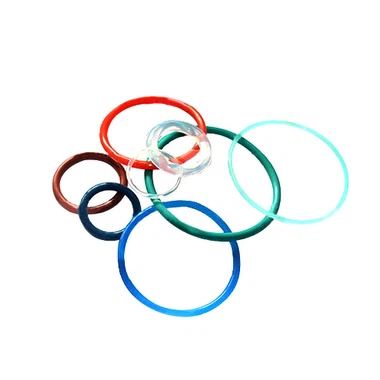
O-ring is a rubber ring with a circular cross-section. Because its cross-section is O-shaped, it is called O-ring. , Also called O-ring. It began to appear in the middle of the 19th century, when it was used as a sealing element for steam engine cylinders. It is the most widely used one in hydraulic and pneumatic transmission systems. It is usually called O-Ring in Taiwanese and Japanese companies.
O-ring is an annular rubber sealing ring with a circular cross-section. It is mainly used for mechanical parts to prevent the leakage of liquid and gaseous media under static conditions. In some cases. O-ring can also be used for axial reciprocating motion And the dynamic sealing element of low-speed rotating motion. According to different conditions, different materials can be selected to adapt to it.
O-rings are usually selected as large cross-section O-rings as much as possible. In the case of the same gap, the volume of O-rings squeezed into the gap should be less than the maximum allowable value of squeezed into.
For different types of fixed sealing or dynamic sealing applications, o-ring seals provide designers with an effective and economical sealing element. O-ring is a two-way sealing element. The initial compression in the radial or axial direction during installation gives the o-ring its own initial sealing ability. The sealing force produced by the system pressure and the initial sealing force are combined into the total sealing force, which increases with the increase of the system pressure. The o-ring shows a prominent role in static sealing occasions. However, in appropriate dynamic occasions, o-rings are often used, but it is limited by the speed and pressure of the seal.
Has the following advantages:
1) The structure is small and exquisite, easy to install and disassemble,
2) Both static and dynamic seals can be used,
3) The dynamic friction resistance is relatively small,
4) Use a single O-ring seal, which can seal in two directions
O-ring specifications and standards
O-ring specifications mainly include UHSO-ring specifications, UHPO-ring specifications, UNO-ring specifications, DHO-ring specifications, piston rod O-ring specifications, high-temperature-resistant O-rings, high-pressure-resistant O-rings, and corrosion-resistant O-rings Ring, wear-resistant O-ring.
The O-ring has excellent sealing performance and high working life. The working life of dynamic pressure seal is 5-10 times longer than that of conventional rubber sealing products, up to tens of times, and it can have the same life as the sealing matrix under certain conditions.
O-ring friction resistance is small, dynamic and static friction forces are equal, which is 1/2-1/4 of the friction force of the "0"-shaped rubber ring, which can eliminate the "crawling" phenomenon of movement at low speed and low pressure.
The O-ring is highly wear-resistant, and has an automatic elastic compensation function after the sealing surface is worn.
O-ring has good self-lubricating performance. It can be used as an oil-free lubrication seal.
O-ring O-ring is simple in structure and easy to install.
O-ring working pressure: 0-300MPa; working speed: ≤15m/s; working temperature: -55-250 degrees.
Applicable medium for O-ring: hydraulic oil, gas, water, mud, crude oil, emulsion, water-glycol, acid.
O-ring applicable scope
The O-shaped sealing ring is suitable for installation on various mechanical equipment, and plays a sealing role in a static or moving state in a specified temperature, pressure, and different liquid and gas media. Various types of seals are widely used in machine tools, ships, automobiles, aerospace equipment, metallurgical machinery, chemical machinery, engineering machinery, construction machinery, mining machinery, petroleum machinery, plastic machinery, agricultural machinery, and various instruments and meters. element. O-rings are mainly used for static sealing and reciprocating sealing. When used for rotary motion sealing, it is limited to low-speed rotary sealing devices. O-rings are generally installed in a groove with a rectangular cross-section on the outer circle or the inner circle for sealing. The O-ring seal still has a good sealing and shock absorption effect in environments such as oil, acid and alkali, abrasion, and chemical erosion. Therefore, O-rings are the most widely used seals in hydraulic and pneumatic transmission systems.
High-performance rubber O-ring
Fluoro Carbon Rubber (Fluoro Carbon Rubber) A rubber containing fluorine in its molecule, depending on the fluorine content (i.e. monomer structure) and various types. At present, the widely used hexafluoride fluorine rubber was first listed by DuPont under the trade name of "Viton". High temperature resistance is better than silicone rubber, it has excellent chemical resistance, resistance to most oils and solvents (except ketones and esters), weather resistance and ozone resistance; cold resistance is poor, and the general use temperature range is -20 ~250 ℃. Special formula can withstand low temperature to -40 ℃.
O-ring (O-ring) is a rubber O-ring with a circular cross-section. Because its cross-section is O-ring, it is called O-ring. Rubber O-rings are the most widely used seals in hydraulic and pneumatic transmission systems. Generally, rubber O-rings are rarely used in rotary motion sealing devices. Rubber O-rings are generally installed in a groove with a rectangular cross-section on the outer circle or the inner circle for sealing.
Fluorine rubber (FKM) is an organic elastomer made by copolymerization of fluorine-containing monomers. Its characteristics are high temperature resistance up to 300℃, acid and alkali resistance, oil resistance is the best in oil resistance rubber, radiation resistance, high vacuum resistance performance; electrical insulation, mechanical properties, chemical corrosion resistance, ozone resistance, atmospheric resistance The aging properties are all excellent. The disadvantages are poor processability, expensive price, poor cold resistance, and low elasticity and air permeability.
Operating temperature range: -40℃~+300℃. With the development of industry, fluorine rubber O-rings are widely used in automobiles, electronics, aerospace, ships, etc., which require relatively high precision, high temperature resistance, high wear resistance, and harsh conditions. With the development of industry, fluorine rubber materials Continuous improvement and innovation are also being made. The following are the properties and scope of application of widely used fluoroelastomer materials.
advantage:
It can withstand heat to 250 ℃, and has resistance to most oils and solvents, especially all acids, aliphatic hydrocarbons, aromatic hydrocarbons, animal and vegetable oils. Good chemical stability, excellent high temperature resistance, good aging resistance, excellent vacuum performance, excellent mechanical performance, good insulation performance, excellent vacuum performance, excellent mechanical performance, good insulation performance
shortcoming:
Not recommended for use in ketones, low molecular weight esters and nitrate-containing mixtures. Automobiles, locomotives, diesel engines and fuel systems.
O-ring product materials mainly include
Nitrile rubber (NBR): This material has a maximum temperature of 130 degrees, a hardness of 50-90 degrees, and a complete range of specifications. It has good mechanical properties and is resistant to mineral-based lubricating oil and grease.
Fluorine rubber (FPM): This material can reach a high temperature of 240 degrees, with a complete range of specifications. It is known for its good performance in high temperature resistance and chemical resistance. In addition, it also has good anti-aging and anti-oxidation, very low gas permeability (especially suitable for true high-altitude installations).
EPDM: The temperature range is -50 degrees to 150 degrees, and it has the characteristics of heat resistance, steam resistance, aging resistance and chemical resistance. It is suitable for hot water, steam, detergent, potassium hydroxide solution, silicone oil and grease, a variety of dilute acids and chemical (medicine) products. It is especially recommended for its resistance to glycol brake fluid, but it is not compatible with all mineral oil products (lubricating oil, fuel).
Silicone (SI): Silicone rubber has the widest operating temperature range (-60-180°C), is harmless, non-toxic and tasteless, has excellent resistance to ozone aging, oxygen aging, light aging and weathering resistance, and excellent electrical insulation Performance, special surface properties and physiological inertia, high air permeability
There are also many materials such as: polyurethane rubber (PU), natural rubber (NR), butyl rubber (BU), sulfonated vulcanized polyethylene (CSM), polytetrafluoroethylene (PTFE), chloroprene rubber (CR), acrylic rubber ( ACM) and other materials.